
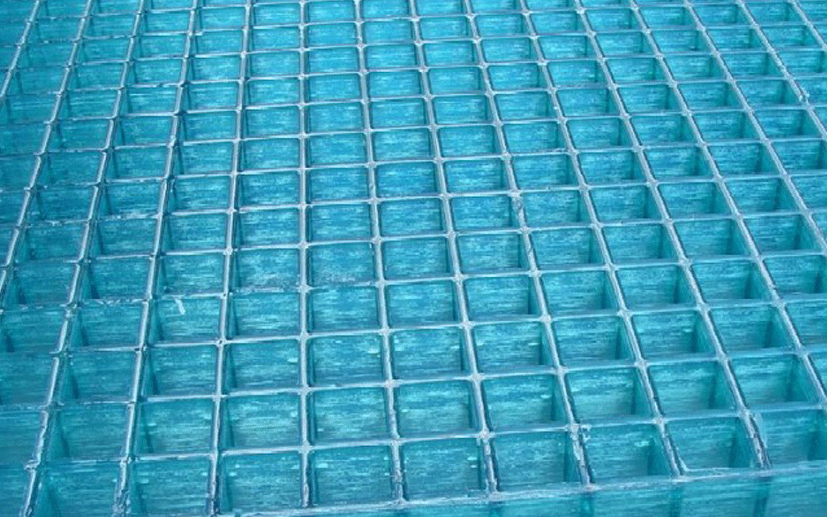
GRP grating is available in two main types — moulded and pultruded — and choosing the right one comes down to the demands of your specific project. Both offer the core advantages that make GRP a popular alternative to steel: corrosion resistance, anti-slip performance, low maintenance and lightweight handling. But they differ in how they’re manufactured, how they handle loads, and where they perform best.
This guide breaks down the key differences so you can specify the right grating first time.
How They’re Made
The manufacturing process is what gives each type its distinct characteristics.
Moulded GRP grating is produced by layering glass fibre rovings and resin into a mould in alternating directions. The resin and glass are compressed together to form a single, one-piece panel. Because the glass fibres run in both directions, the finished panel has bi-directional strength — it performs equally well regardless of which way it’s orientated.
Pultruded GRP grating is made by pulling continuous glass fibre rovings through a resin bath and then through a heated die. This creates individual bearing bars — typically with a T or I-shaped profile — which are then assembled with cross rods to form the finished panel. The continuous glass fibres run in one direction, giving pultruded grating uni-directional strength — it’s strongest along the length of the bearing bars.
Strength and Load Capacity
This is often the deciding factor.
Pultruded grating has a higher glass-to-resin ratio than moulded grating, which gives it greater stiffness and a higher load-bearing capacity for a given panel thickness. It can also span longer distances between supports without deflection, making it the go-to choice for heavy-duty industrial platforms, vehicle-rated areas, and applications where support frames are spaced further apart.
Moulded grating, while not as stiff, is no lightweight performer. Its bi-directional strength means it handles loads evenly from any direction, which makes it well suited to pedestrian walkways, stair treads, trench covers, and areas where panels may be lifted, rotated, or repositioned during maintenance.
Corrosion and Chemical Resistance
Both types resist corrosion far better than steel, but moulded grating has the edge here. Its higher resin content gives it superior resistance to a wider range of chemicals, acids, alkalis and solvents. This makes moulded GRP grating particularly well suited to aggressive environments such as water treatment works, chemical processing plants, and coastal or marine installations where salt spray is a constant factor.
Pultruded grating still offers excellent corrosion resistance — comfortably outperforming galvanised steel, aluminium, and even stainless steel in many environments. For the majority of industrial and commercial applications, its corrosion performance is more than adequate.
Where the environment involves sustained exposure to strong acids or particularly aggressive chemicals, specifying a vinyl ester resin system (available in both types) significantly boosts resistance.
Weight and Handling
Both moulded and pultruded GRP grating are substantially lighter than steel equivalents — typically around a third of the weight. This reduces installation time, cuts transport costs, and means panels can be manoeuvred by hand without heavy lifting equipment.
Moulded panels tend to be marginally heavier than pultruded panels of the same size, due to the higher resin content. In practice, the difference is rarely significant enough to affect installation.
Impact Resistance
Moulded grating is more flexible and absorbs impact energy better than pultruded grating. Its higher resin concentration allows it to flex under sudden loads without cracking. This makes it a better choice in environments where dropped tools, falling objects, or sudden point loads are a regular occurrence — think maintenance platforms, plant rooms, and workshop floors.
Pultruded grating is stiffer by design. It resists deflection well under sustained loads, but is more prone to localised damage from sharp impacts.
Anti-Slip Performance
Both types are available with a bonded grit anti-slip surface, providing excellent grip in wet, oily, and icy conditions. The anti-slip properties are a function of the surface finish rather than the grating type, so in terms of pedestrian safety, both moulded and pultruded grating perform equally well.
The open mesh design of both types also allows water, debris, and spills to drain through, reducing the build-up of surface hazards.
Quick Comparison
| Feature | Moulded GRP Grating | Pultruded GRP Grating |
|---|---|---|
| Strength direction | Bi-directional (equal both ways) | Uni-directional (strongest along bearing bars) |
| Load capacity | Moderate to high | High to very high |
| Span capability | Shorter spans | Longer spans between supports |
| Corrosion resistance | Excellent (higher resin content) | Very good |
| Impact resistance | Higher — more flexible | Lower — stiffer |
| Weight | Slightly heavier | Slightly lighter |
| Best for | Walkways, treads, trench covers, chemical environments | Heavy-duty platforms, vehicle areas, long-span applications |
Which Should You Choose?
Choose moulded GRP grating if:
- The application is primarily pedestrian walkways, stair treads, or trench covers
- Panels may need to be lifted and repositioned regularly
- The environment involves sustained chemical or acid exposure
- Impact resistance is a concern (dropped tools, falling objects)
- Support frames are relatively closely spaced
Choose pultruded GRP grating if:
- The application demands higher load ratings or vehicle access
- You need to span longer distances between supports
- Maximum stiffness and minimal deflection are priorities
- The project involves heavy industrial platforms or major infrastructure
For many general-purpose commercial and industrial projects — walkways, platforms, plant room floors — moulded GRP grating is the most versatile and cost-effective option. When the engineering demands step up, pultruded grating delivers the extra structural performance.
Not Sure Which Type You Need?
At Grating Direct, our open mesh panels are moulded, and we also supply mini mesh and covered top panels, in a range of thicknesses and colours. If you’re unsure which type suits your project, we’re happy to help with specification advice.
Browse our full GRP grating range or get in touch for technical guidance and pricing.
Shop moulded grating and pultruded profiles
Everything you need for a GRP floor, from panels to supports.
Need advice? Call 01480 570001, Monday to Friday 9am to 6pm.
