
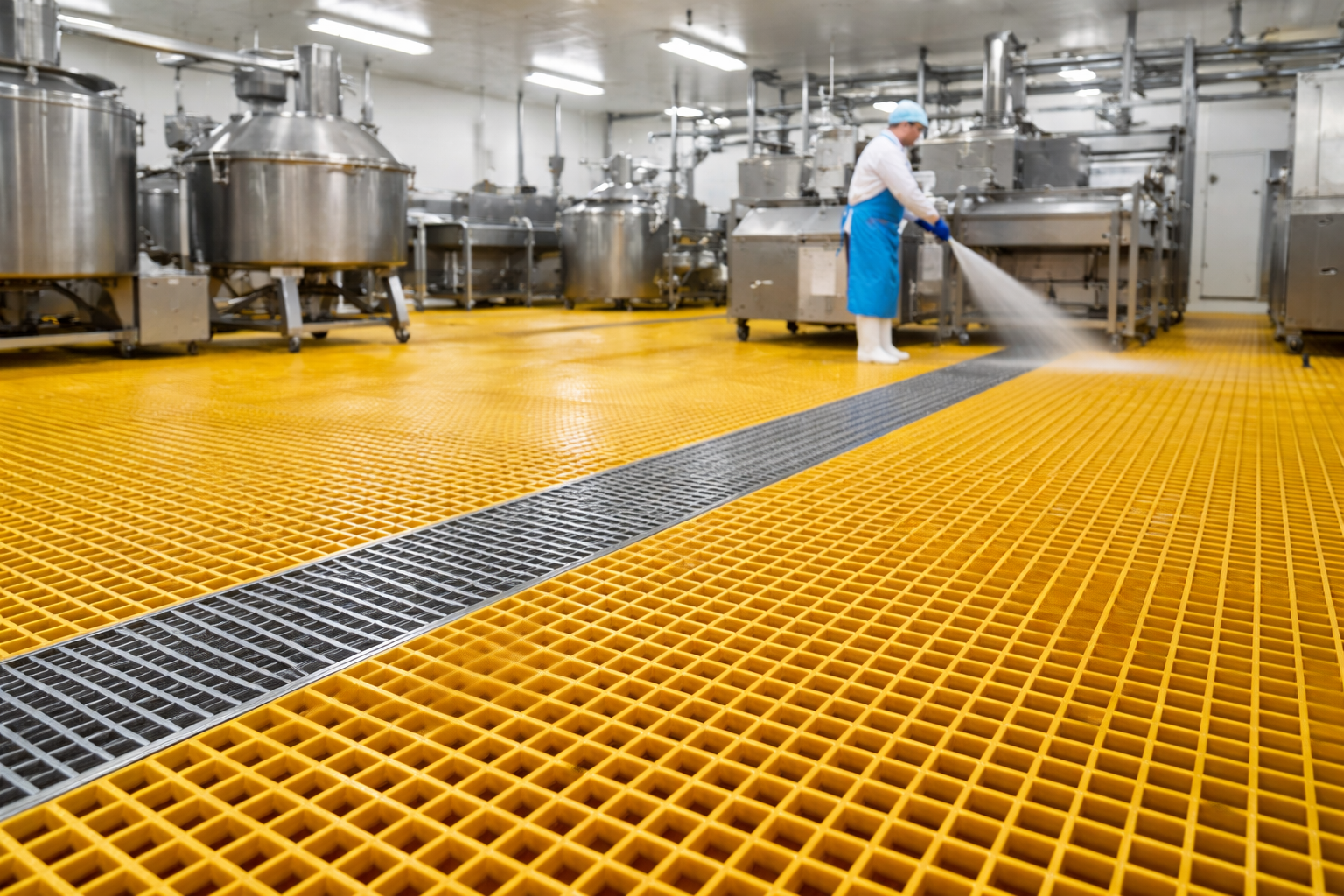
Why GRP Grating Is Perfect for Food Production Facilities
Food production facilities demand the highest standards of hygiene, safety and durability. Flooring and walkways must withstand frequent washdowns, exposure to chemicals, temperature changes, and constant foot traffic.
GRP grating (Glass Reinforced Plastic grating) has become one of the most popular flooring solutions in food manufacturing because it meets all of these requirements while offering long-term reliability and low maintenance.
Excellent corrosion resistance
Food production environments regularly use:
-
Cleaning chemicals
-
Sanitisers
-
Degreasers
-
Salt and acidic food products
Traditional steel grating can corrode over time when exposed to these substances, leading to structural weakness and hygiene issues.
GRP grating is naturally corrosion resistant and will not rust, making it ideal for:
-
Food factories
-
Meat processing plants
-
Dairy facilities
-
Breweries
-
Commercial kitchens
This ensures a longer lifespan and lower replacement costs.
Hygienic and easy to clean
Maintaining hygiene is critical in food production, and GRP grating supports strict cleaning regimes.
GRP grating offers:
-
Non-porous surface that does not absorb liquids
-
Resistance to bacterial growth
-
Compatibility with pressure washing and chemical cleaning
-
Open mesh design that allows debris and liquids to drain through
This helps maintain clean, compliant production environments.
Outstanding slip resistance
Wet floors are unavoidable in food production due to:
-
Washdowns
-
Spills
-
Condensation
-
Cleaning processes
GRP grating features an integral anti-slip surface that provides excellent grip even when wet or greasy.
This significantly reduces the risk of slips and workplace injuries, helping improve safety compliance.
Lightweight and easy to install
GRP grating is much lighter than steel while maintaining excellent strength.
This provides several advantages:
-
Easier manual handling
-
Faster installation
-
Reduced labour costs
-
Lower structural load on buildings
It can also be easily cut on site to fit around equipment and machinery.
Resistant to moisture and temperature changes
Food production environments often experience:
-
High humidity
-
Frequent washdowns
-
Temperature variations
-
Cold storage conditions
GRP grating does not absorb moisture and will not warp, rot or degrade in wet environments.
This makes it suitable for both indoor and outdoor food processing areas.
Low maintenance and long lifespan
Unlike steel grating, GRP does not require:
-
Painting
-
Galvanising
-
Rust treatment
This results in lower maintenance costs over time and reduces downtime for repairs.
GRP grating can last for many years even in demanding food production environments.
Electrically and thermally non-conductive
GRP grating is non-conductive, which provides additional safety around electrical equipment commonly found in food factories.
It is also thermally stable, making it suitable for areas exposed to temperature changes.
Typical applications in food production facilities
GRP grating is commonly used for:
-
Production floor walkways
-
Access platforms
-
Drain covers
-
Plant access areas
-
Mezzanine floors
-
Washdown areas
-
External walkways
Its durability and hygiene benefits make it suitable throughout the facility.
A cost-effective long-term solution
Although the initial cost may be similar to steel, GRP grating offers significant long-term savings through:
-
Longer lifespan
-
Reduced maintenance
-
No corrosion
-
Improved safety
-
Easier installation
This makes it a smart investment for food production businesses.
GRP grating is an ideal flooring solution for food production facilities due to its corrosion resistance, hygienic properties, slip resistance and long lifespan.
It provides a safe, durable and low-maintenance option that helps food manufacturers maintain high standards while reducing long-term costs.
Add Comment