
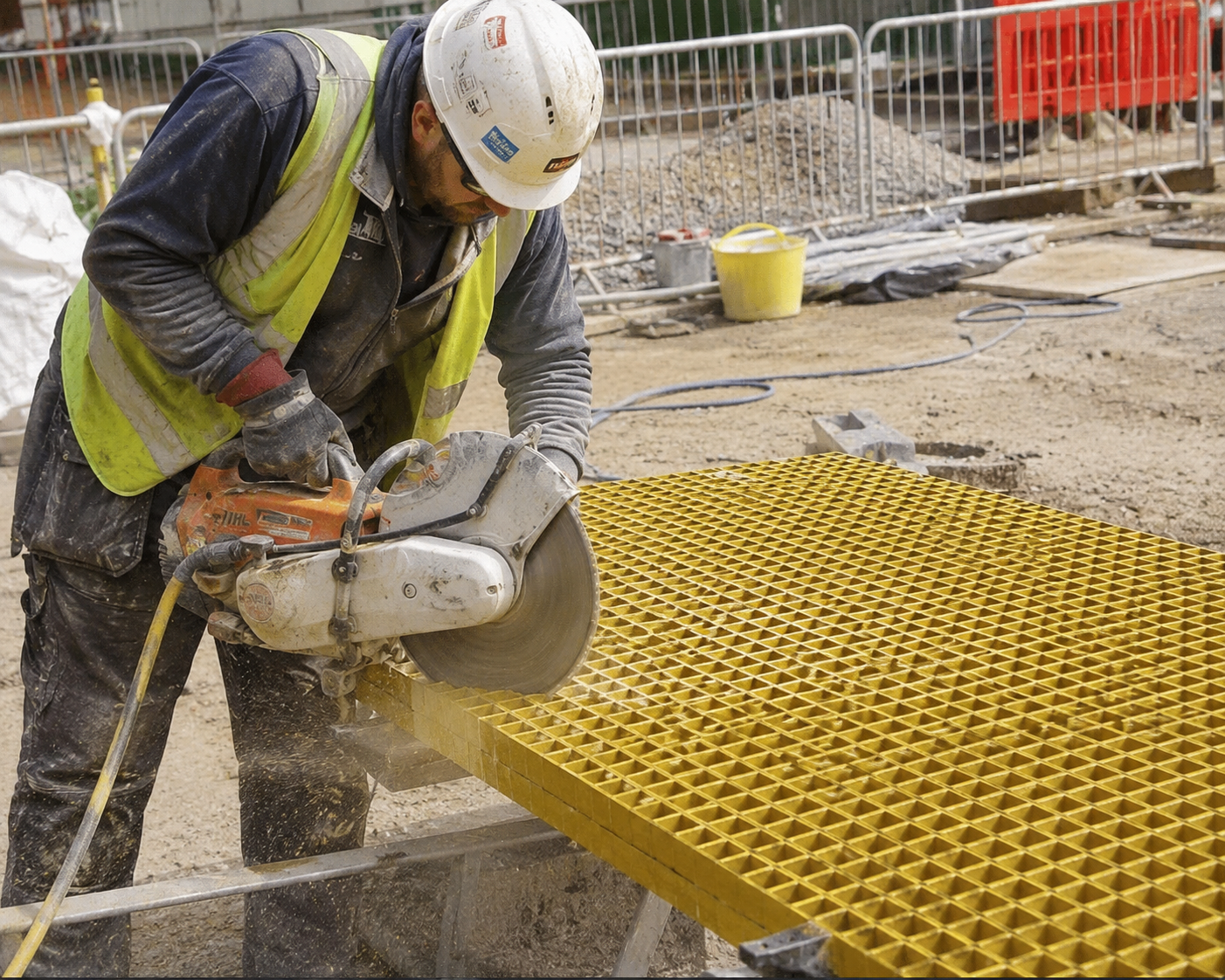
GRP grating is supplied in standard panel sizes, but most installations need on-site cutting to suit penetrations, kerb cut-outs, drainage channels or bespoke aperture work. Done well, cutting GRP is straightforward. Done poorly, it raises serious HSE concerns around airborne glass fibre, slows the install and can compromise the long-term performance of the panel. This guide sets out how to cut GRP grating cleanly, safely and in line with current site safety expectations.
Why cutting GRP demands a different approach to steel
GRP is a composite of glass fibres bound in polyester or vinyl ester resin. That structure is what gives it the corrosion resistance and strength-to-weight ratio that engineers like. It also means cutting behaves nothing like cutting steel.
- Cutting releases fine glass fibre dust, which is a respiratory and skin irritant.
- Heat and friction from the wrong blade can damage the resin matrix at the cut line.
- Freshly exposed edges lose the corrosion resistance of the factory-sealed surface and must be re-sealed.
- The wrong blade choice will wear out fast and produce a ragged edge.
The right tools for cutting GRP grating
Straight cuts
A diamond grit continuous rim blade is the best choice for clean straight cuts on a circular or chop saw. Tungsten carbide-tipped (TCT) blades will work for occasional cuts but wear quickly when used regularly on GRP, especially on mini mesh and covered top panels. For wet cutting, a diamond blade in a water-cooled saw produces the cleanest finish and the least airborne dust.
Curves, notches and apertures
A jigsaw fitted with a diamond grit jigsaw blade handles internal cut-outs, kerb returns and complex shapes. For circular penetrations, a diamond hole saw cuts neatly without splintering the resin face. A reciprocating saw with a carbide grit blade is useful for thicker covered top panels and site adjustments where access is tight.
Dust control: meeting HSE expectations
The HSE classifies machine-generated glass fibre dust as harmful, and treats GRP cutting as a higher-risk activity than equivalent steel work. A workable on-site dust control strategy needs all of the following:
- On-tool extraction connected to an M Class vacuum, or local exhaust ventilation in a fixed cutting station.
- Wet cutting wherever practical, which is the single most effective way to suppress airborne fibres.
- FFP3-rated respiratory protection as a minimum for the operator and anyone within the work area.
- Long sleeves, gloves and sealed safety goggles. Loose glass fibre causes immediate skin and eye irritation.
- A controlled cutting area, with the surrounding zone screened off in occupied buildings.
If your site has dust monitoring in place, expect a spike during GRP cutting. Plan cutting work outside of peak occupancy hours where possible.
Sealing cut edges
Every cut exposes raw glass fibres. In dry indoor environments this is cosmetic; in wet, chemical or food production environments, an unsealed edge becomes the first failure point of the panel. Apply a compatible resin sealer or two-part epoxy to all cut faces. This restores the corrosion barrier, prevents fibre bloom in service and stops moisture wicking into the panel. Allow 24 hours to cure before installing into a wet area or returning to service.
When to specify cut-to-size panels instead
For complex installs, ordering GRP grating cut to size from the supplier saves site hours, removes the dust risk from your programme and gives factory-sealed edges as standard. This is usually the right call for service riser layouts, plant rooms with multiple penetrations, irregular platforms and any retrofit where site access is limited. Provide a marked-up plan with aperture positions, kerb cut-outs and any mitre cuts at the quote stage.
Common cutting mistakes to avoid
- Using a worn or general-purpose blade that scorches the resin and tears the fibres.
- Cutting indoors with no dust extraction and no respiratory protection.
- Forgetting to re-seal cut edges before installation.
- Cutting close to live plant, services or running production lines without proper segregation.
- Stacking off-cuts without bagging them. Loose GRP off-cuts shed fibres into the wider site.
Get the right GRP grating for the job
Whether you need stock panels for a straightforward walkway or fully cut-to-size sheets for a complex platform, Grating Direct supplies the full range of moulded and pultruded GRP grating from UK stock with next-day delivery. For bespoke cuts, use the bespoke quotation service and send through your drawings. For full technical data on each panel, see the load deflection and chemical resistance pages on the website.
Cutting GRP grating FAQs
How do you cut GRP grating?
Cut GRP grating with a circular saw or angle grinder fitted with a diamond grit or fine-tooth blade, supporting the panel and cutting along the bars. Always wear a dust mask, goggles and gloves, and seal the cut ends with resin.
What blade should I use to cut GRP grating?
A diamond grit blade or a fine-tooth carbide blade gives the cleanest cut and the longest blade life.
Do you need to seal cut GRP grating?
Yes. Apply a resin sealant to exposed cut edges to protect the glass fibres from moisture and chemical attack and to maintain the panel’s service life.


Add Comment