
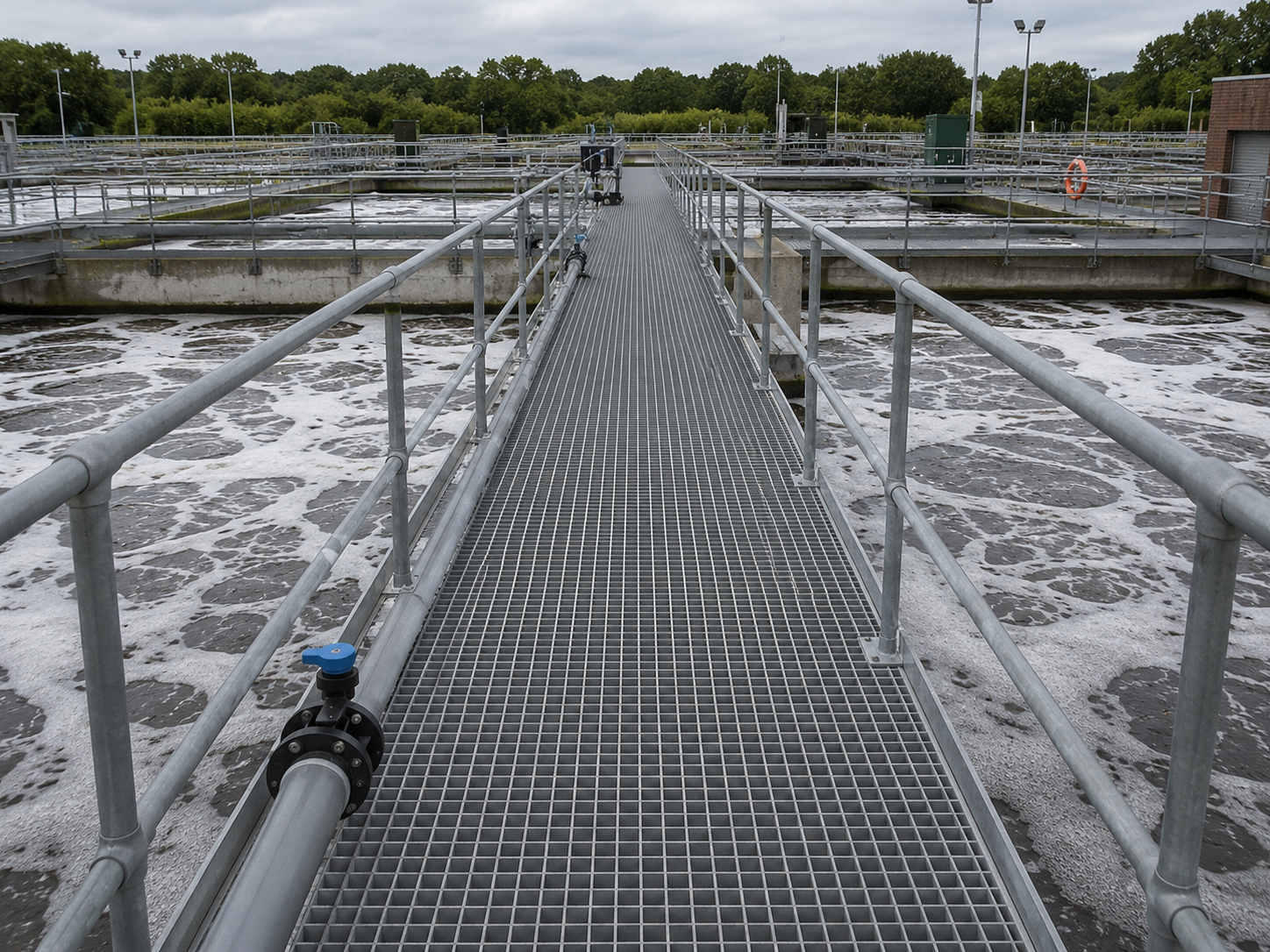
Water and wastewater treatment sites are among the most aggressive environments any flooring or access system has to deal with. Constant moisture, sulphuric acid dosing, sodium hypochlorite, ferric chloride and biological growth all attack conventional steel structures within a few years of installation. GRP grating has become the default specification for new build and refurbishment projects in this sector because it solves these problems at source rather than relying on protective coatings.
Why steel struggles in water treatment environments
Hot dip galvanising performs well in a clean atmosphere but fails quickly in chloride and sulphide-rich plant rooms. White rust forms within months, and red rust follows. Stainless steel is more durable but costs significantly more, still pits under sustained chloride attack, and adds weight that complicates panel removal for tank entry. Painted carbon steel grating has the shortest service life of all and demands a planned maintenance budget for repainting that rarely survives a few rounds of value engineering.
The hidden cost is operational. Every repaint, replate or replacement is a planned shutdown, scaffolding hire and a permit-to-work. GRP removes that cost line entirely.
Where GRP grating is typically used on a treatment site
Walkways above tanks and channels
Continuous GRP panels carry inspection and operator traffic over aeration lanes, settlement tanks, sludge channels and screening houses. Anti-slip grit finish handles wet, algae-prone surfaces that defeat steel chequer plate.
Access platforms for screens, scrapers and aerators
Light panel weight makes single-operator removal feasible for inspection access. Sections can be cut and re-sealed on site for retrofits without hot work permits.
Inspection covers and trench grating
Mini mesh GRP suits trench covers where dropped tools must be retained, and where pedestrian heel safety is a factor in occupied buildings.
Stair treads and ladder rungs in chemical dosing rooms
Chlorine dosing, ferric, polymer and lime dosing rooms are the most chemically aggressive on a treatment plant. Vinyl ester GRP stair treads outlast painted steel by an order of magnitude.
The technical reasons GRP works in this sector
- Chemical resistance to the full suite of treatment plant chemicals when specified with the correct resin system.
- Integral slip resistance from a moulded grit top surface, classified to BS 7976.
- Weight typically less than half that of equivalent steel, which improves manual handling for confined space entry.
- Non-conductive and non-magnetic, useful around variable speed drives, instrumentation and electrochlorination plant.
- Service life of 25 years or more with no painting cycle, removing a recurring opex line.
Specifying GRP for treatment plant projects
Resin system
Isophthalic polyester is the default for general plant walkways and clean water side applications. Where the panel will see prolonged exposure to sodium hypochlorite, ferric chloride or aggressive sludge liquor, specify vinyl ester. The cost uplift is modest compared to the service life gain.
Mesh size
Standard 38mm mesh is fine for areas with high water flow and good drainage. Specify mini mesh (14mm) where dropped tools or small instrumentation must be retained, on inspection platforms above sensitive equipment, and on heel-safe routes.
Fire rating
Chemical stores, electrical rooms and motor control centres should be specified to BS 476 Class 1 surface spread of flame as a minimum. Confirm with the principal designer at RIBA Stage 4.
Hi-vis edges and nosings
Yellow nosings on stair treads and platform edges improve compliance with workplace lighting requirements and reduce slip and trip incidents during low-light callouts.
Whole-life cost: where the GRP business case wins
On a like-for-like initial cost basis, GRP grating is often comparable to galvanised steel and cheaper than stainless. The difference shows up across a 25-year horizon. There is no painting cycle, no descaling, no scaffold hire for routine maintenance and no replacement programme. Insurance and HSE risk also reduces, because confined space entries for corrosion repair drop to near zero.
Build a robust specification with Grating Direct
Grating Direct supplies moulded GRP grating in open mesh, mini mesh and covered top, the 48.5mm interlocking structural slab, stair treads and pultruded profiles for water and wastewater applications, with chemical resistance data and load deflection tables available on the website. For project-specific specifications, request a bespoke quotation with your tank and platform drawings.
For other sectors, see our guide to GRP grating applications by industry.
Buying GRP grating?
Grating Direct supplies GRP grating, stair treads, platforms and fixings, with standard panels held in UK stock.
Need advice? Call 01480 570001, Monday to Friday 9am to 6pm.

Add Comment